How Much Does It Cost to Host and Maintain a Business Web Application?
Launching a business web application involves more than paying for development. Businesses must also budget for hosting, domain registration, security,…
Launching a business web application involves more than paying for development. Businesses must also budget for hosting, domain registration, security, database management, backups, monitoring, and ongoing maintenance.
The total cost depends on the application's complexity, number of users, server requirements, storage needs, and expected traffic. A small business application may run on an affordable hosting plan, while a large enterprise platform may require multiple servers, managed databases, and dedicated support.
In this guide, we will explain the main costs of hosting and maintaining a business web application, compare common hosting options, and show how businesses can control expenses as their applications grow.
1. Understand the Main Costs of a Business Web Application
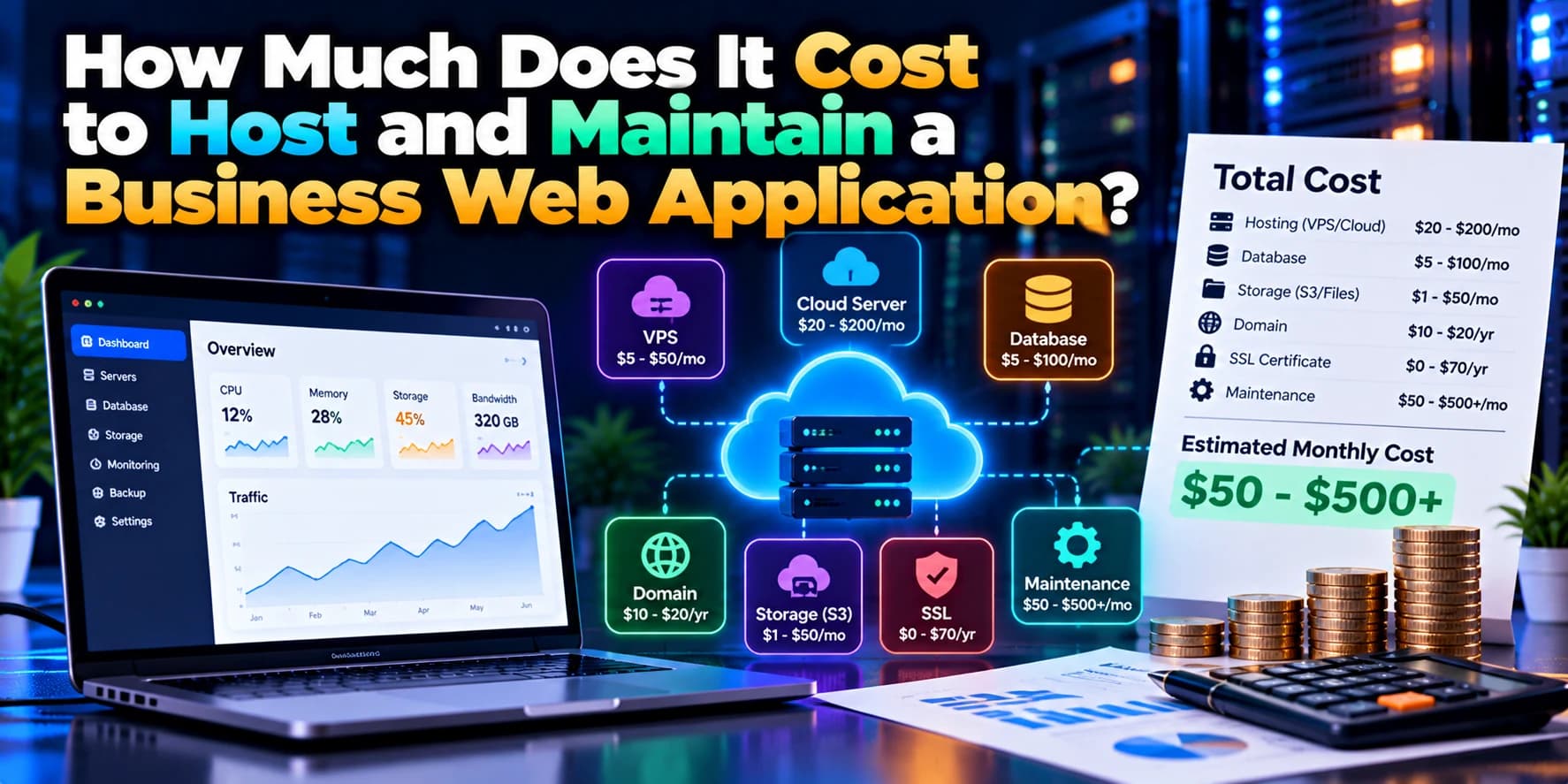
The total cost of running a web application typically includes several categories:
Hosting and infrastructure: Servers, cloud services, storage, and bandwidth.
Domain and DNS: Domain registration and related services.
Database management: Database hosting, backups, and performance optimization.
Security: SSL/TLS certificates, firewalls, access controls, and security monitoring.
Maintenance: Bug fixes, dependency updates, and application improvements.
Monitoring and backups: Uptime monitoring, logs, alerts, and recovery systems.
Third-party services: Email delivery, payment gateways, APIs, and other integrations.
These costs can be billed monthly, annually, or according to usage. Separating them into categories makes it easier to estimate the actual cost of operating an application.
2. Compare Different Hosting Options
Choosing the right hosting provider is one of the most important cost decisions.
Shared Hosting
Shared hosting allows multiple websites to use resources on the same server. It is suitable for simple business websites and some lightweight applications.
Estimated cost: ₹200–₹1,500 per month.
Advantages include low cost and relatively simple management. However, resource limitations may make shared hosting unsuitable for applications with demanding workloads, background jobs, or growing traffic.
VPS Hosting
A Virtual Private Server provides allocated resources and more control over the software environment.
Estimated cost: ₹800–₹8,000 per month.
VPS hosting can be a practical choice for startups, internal business tools, customer portals, and small-to-medium web applications.
The final price depends on CPU, RAM, storage, bandwidth, provider, and whether managed support is included.
Cloud Hosting
Cloud platforms such as AWS, Microsoft Azure, and Google Cloud offer configurable infrastructure and a range of managed services.
Estimated cost: ₹2,000–₹30,000+ per month for many small-to-medium deployments.
Cloud hosting can provide flexible scaling, managed databases, load balancing, object storage, and monitoring. Costs may increase when an application needs multiple servers, high availability, large data transfers, or extensive managed services.
Dedicated Server Hosting
A dedicated server provides an entire physical server for your workload.
Estimated cost: ₹8,000–₹40,000+ per month.
It may suit applications with substantial and predictable resource requirements. However, hardware upgrades, operational management, and redundancy can add to the overall cost.
These are indicative planning ranges, not provider quotations. Actual prices vary by region, specifications, provider, taxes, and usage.
3. Calculate Monthly Server and Infrastructure Costs
Server costs depend on how your application uses computing resources.
For example, a business web application may need:
An application server to process user requests.
A database server to store business data.
Storage for documents, images, and uploads.
Bandwidth for incoming and outgoing traffic.
A load balancer if traffic is distributed across multiple instances.
A basic application may run on one server, while a more demanding platform may separate the database and application workloads.
Avoid purchasing excessive resources before measuring actual usage. Start with an appropriate configuration, monitor performance, and scale when CPU, memory, response time, or database metrics indicate a need.
4. Include Database Hosting and Storage Costs
Databases are a major part of many business applications. They store customer information, orders, transactions, employee records, and other business data.
Common options include running a database on your own server or using a managed database service.
The main cost factors are:
Database CPU and memory requirements.
Storage capacity and performance.
Automated backups and retention.
High availability and replication.
Data transfer and recovery requirements.
Managed databases may cost more than running a database on an existing server, but they can reduce the operational work involved in patching, backups, and maintenance.
Similarly, cloud object storage can be useful for uploaded files and documents. Remember to account for storage usage, requests, data transfer, and backup copies.
5. Budget for Domain, SSL, and Security
A business web application needs a secure and reliable way for users to access it.
Common expenses include:
Domain registration: Often around ₹800–₹2,000 per year for common domain extensions, although premium domains can cost much more.
SSL/TLS certificates: Free options such as Let's Encrypt may be sufficient for many websites. Paid certificates or managed services may involve additional charges.
Firewall and access controls: May be included with hosting or billed separately.
Web application firewall (WAF): Optional protection against certain web-based attacks.
Security monitoring: May require paid tools or additional engineering time.
Security costs should be considered alongside the risk of data loss, service interruption, and unauthorized access. A low-cost setup is not necessarily economical if it leaves a business exposed to avoidable incidents.
6. Estimate Ongoing Application Maintenance Costs
Hosting is only one part of the total cost. Applications also require regular technical maintenance.
Typical maintenance activities include:
Fixing bugs and production issues.
Updating frameworks, libraries, and dependencies.
Applying security patches.
Monitoring server and application health.
Improving performance and database queries.
Testing backups and recovery procedures.
Updating features as business requirements change.
For a small business web application, a rough planning budget might be ₹5,000–₹25,000 per month for limited maintenance support. More complex applications that require frequent development, 24/7 support, or formal service-level agreements may cost substantially more.
Maintenance pricing depends on the provider's rates, application complexity, support hours, and included services. Clarify whether emergency fixes, new features, and major upgrades are included in the maintenance agreement.
7. Account for Third-Party API and Service Costs
Many business applications depend on external services to provide essential functionality.
Examples include:
Email and SMS notifications.
Payment gateway services.
Maps and geolocation APIs.
Identity and document verification APIs.
AI APIs and automation services.
Analytics and error tracking.
File processing and document generation.
Some services have free tiers, while others charge per request, transaction, message, or unit of usage.
Estimate monthly consumption using realistic assumptions. For example, calculate expected emails, SMS messages, payment transactions, or API calls rather than relying only on the advertised starting price.
8. Example Monthly Cost for a Small Business Web Application
Consider a business application with moderate traffic, a database, file storage, backups, and basic maintenance.
The following example illustrates how costs can be budgeted.
Expense | Estimated monthly cost |
|---|---|
Application server or cloud hosting | ₹2,000 |
Database and storage | ₹1,000 |
Backups and monitoring | ₹500 |
Domain cost, averaged monthly | ₹100 |
Security and related services | ₹500 |
Maintenance and technical support | ₹10,000 |
Third-party APIs and email services | ₹1,000 |
Estimated total | ₹15,100/month |
This is an illustrative budget, not a universal market price. It assumes a relatively simple application and limited maintenance support. Actual costs may be lower for a very small deployment or much higher for a production system with strict uptime, compliance, or scaling requirements.
Also distinguish ongoing operating costs from one-time development costs, migration expenses, and major feature enhancements.
9. How to Reduce Web Application Hosting and Maintenance Costs
Businesses can reduce unnecessary expenses without compromising essential reliability.
Choose Resources Based on Actual Usage
Monitor CPU, memory, storage, and network usage before upgrading your server. Right-size resources instead of paying for capacity that the application does not need.
Use Caching and a CDN
Caching reduces repeated processing, while a content delivery network can serve eligible static assets closer to users. This can improve performance and reduce load on the application server.
Automate Deployments and Backups
CI/CD pipelines can reduce manual deployment work. Automated backups and tested recovery procedures can reduce the effort required to recover from failures.
Remove Unused Resources
Review unused cloud instances, old storage volumes, unnecessary snapshots, and idle development environments. Set appropriate retention policies before deleting resources.
Monitor Third-Party Service Usage
Track API calls, email volume, storage requests, and data transfer. Configure budget alerts and usage limits where supported.
Plan Maintenance Proactively
Regular updates and monitoring can help identify problems before they cause expensive downtime. A defined maintenance plan can also make monthly expenses more predictable.
10. How to Choose the Right Hosting Budget for Your Business
Before selecting a hosting plan, answer these questions:
How many users will access the application?
How much traffic and database activity do you expect?
Does the application store sensitive or business-critical data?
How much downtime can your business tolerate?
Do you need automated backups and disaster recovery?
Does your application require paid APIs or third-party integrations?
Who will handle server monitoring, updates, and emergency fixes?
How quickly do you expect the application to grow?
A small internal tool may need only a basic server and occasional maintenance. A customer-facing platform handling payments or important business records may require stronger security, backups, redundancy, and more active support.
Choose a budget that covers both the infrastructure and the work needed to operate it safely.
Conclusion
The cost of hosting and maintaining a business web application depends on its infrastructure, traffic, security requirements, integrations, and ongoing support needs. A basic deployment may cost a few thousand rupees per month, while a larger, highly available application can require a substantially higher budget.
To estimate costs accurately, list your hosting, database, storage, security, monitoring, API, and maintenance expenses separately. Then choose resources based on expected usage and review actual spending as your application grows.
Need help planning your web application infrastructure? Dotcube Technologies helps businesses develop and maintain web applications, choose suitable hosting solutions, and plan scalable infrastructure based on their technical requirements and budget. Contact our team to discuss your project.